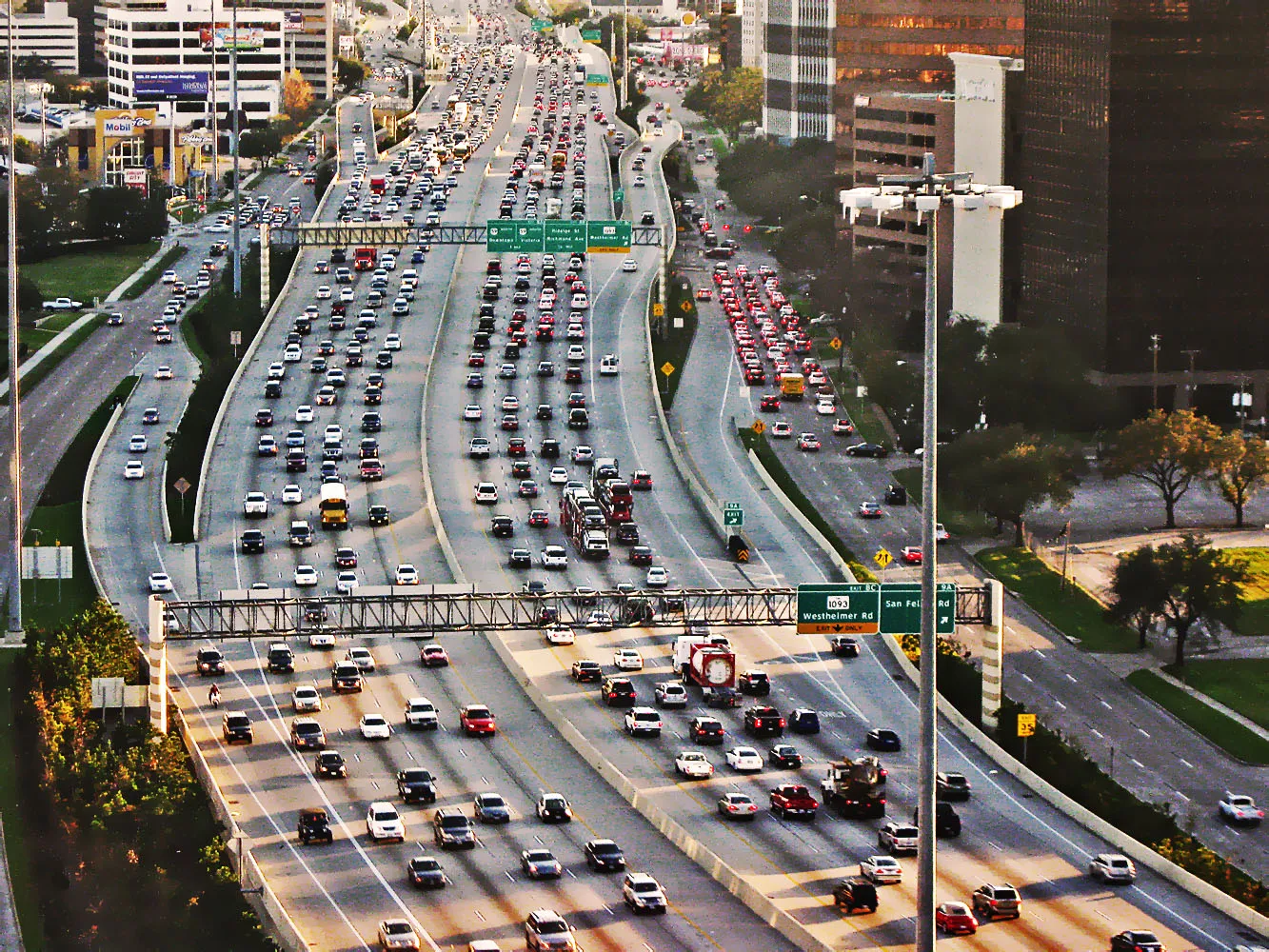
Washington is Creating the Most Expensive Traffic Jam in the World
On April 20, the Federal Highway Administration launched its “Freedom to Drive” initiative, asking governors to nominate their worst traffic bottlenecks for federal capacity expansion. On May 17, House transportation leaders released the draft BUILD America 250 Act — a $580 billion, five-year surface transportation reauthorization, which the House Transportation and Infrastructure Committee marked up on May 21.
Read more Does Your City Need a ‘Department of Sidewalks’?
Taken together, the two announcements amount to the largest federal sprawl subsidy in a generation, proposed at exactly the moment American households can least afford it.
There is a real freedom in being able to drive. But the “freedom” the initiative actually delivers isn’t “freedom” at all, because it leaves households with no alternatives.
For roughly 30 percent of Americans — children, older adults, people with disabilities, and households without a vehicle — driving is not an option. For nearly everyone else, the built environment makes it the only practical way to reach a job or a grocery store. We have grown so used to automobile dependence that we no longer notice the shackles. The “freedom” on offer is pure car-dealer Americana — red, white, blue, and one more promise that the next round of expansion will finally clear the traffic.
Start with the household ledger. The Bureau of Labor Statistics reports that American households spent an average of $78,535 in 2024 — 33.4 percent on housing and 17.0 percent on transportation, more than half of household spending. The Center for Neighborhood Technology’s Housing + Transportation Affordability Index sets the combined affordability ceiling at 45 percent of household income, and most U.S. communities routinely exceed it.
But the H+T Index measures only direct household costs. It does not capture the federal subsidy that engineered the sprawl pattern, which households absorb, and it does not show how that subsidy gets returned in degraded form.
Federal, state, and local governments spent $626 billion on transportation and water infrastructure in 2023, with highways as the largest category. Federal capacity expansion is increasingly deficit-financed, and households pay it back through inflated prices, eroded wages, and higher mortgage rates.
The road bill never goes away. It just gets routed through the dollar.
Beth Osborne at Smart Growth America has argued for years that the federal performance-measurement framework is structurally biased toward expansion: we count vehicle throughput, not access, and the incentives push state DOTs to build new capacity rather than maintain what they already own. Her organization’s Repair Priorities reports have tracked this misallocation for over a decade.
Chuck Marohn at Strong Towns arrives at the same diagnosis from a different tradition. He argues that the postwar suburban development pattern is financially insolvent because its maintenance liabilities exceed the tax base it produces, which he calls the “growth Ponzi scheme.”
Different schools, same conclusion: we are buying liabilities and calling them assets.
Read more These Advocates Are Mapping — and Grading — Every Bike Rack In Town
BUILD America 250 is the diagnosis in legislative form. It does real work—bridges need repair, freight matters, road workers deserve protection. But the architecture is backward. The bill cuts Safe Streets and Roads for All by $1.25 billion, eliminates the Carbon Reduction and PROTECT resilience programs, and repeals the Active Transportation Infrastructure Investment Program — the only dedicated federal source for closing gaps in walking and biking networks, whose first grant round was oversubscribed forty to one.
It then channels new money into capacity expansion at the moment traffic deaths remain at 39,254 a year. In their recent update of the U.S. sprawl index, Shima Hamidi’s Johns Hopkins team ties those deaths directly to the development pattern federal road dollars keep subsidizing: more vehicle miles and higher speeds, which lead to elevated rates of fatal and pedestrian crashes.
The fiscal logic gets worse. The federal gas tax sits at 18.4 cents per gallon for gasoline and 24.4 cents for diesel — unchanged since 1993. Users should pay for the infrastructure they use; that has historically been the conservative position.
But even as Congress writes new revenue streams to shore up the Highway Trust Fund, Washington is floating a gas-tax holiday in response to another Middle East conflict. The Bipartisan Policy Center estimates a five-month suspension would cost the trust fund roughly $17 billion — 46 percent of projected FY2026 fuel-tax revenue.
So the user fee that funds roads gets suspended because of an oil shock to which the road system itself made us all vulnerable — while Congress fills the gap by borrowing, and households pay back the borrowing through devalued wages.
That isn’t conservatism. It’s debt-financed dependency with a flag decal.
A serious conservative transportation policy starts from three principles: maintenance before expansion, pricing before subsidy, and access before throughput.
Roads, freight, emergency access, and rural connectivity all matter. The argument isn’t road abolition. It’s fiscal sanity — and a refusal to keep mailing U.S. households the bill for a development pattern that bankrupts it.
America is not underinvesting in roads. It is overbuilding liabilities and underpricing their true cost. “Freedom to Drive” isn’t a new vision. It’s the same old invoice — stamped urgent, mailed to taxpayers, and wrapped in red, white, and blue.
